Dog-Friendly Hikes in Mammoth Lakes: Trail & Lake Guide
Plan dog-friendly hikes in Mammoth Lakes with leash rules, lake trails and alpine heat tips, then finish at a patio that publishes dog-friendly seating.
On this page
Mammoth Lakes suits dogs because the town, the Lakes Basin and the trailheads sit close together, so a short drive separates a morning swim from a brewery patio. The trade-off is that trailheads are often full by mid-morning in summer, and the altitude and dry air tire dogs faster than the mileage suggests. Pick two hikes rather than five, start early, and carry more water than you would at home. The same altitude-and-heat logic shapes dog friendly hikes albuquerque, where an early start matters just as much.
This guide pairs each route with its trailhead and round-trip distance so you can match a trail to your dog's fitness, from a flat shoreline wander at Horseshoe Lake to the climb to TJ Lake. It also separates leash rules in developed areas from voice-control allowances in undeveloped forest and wilderness, and it flags the Devils Postpile shuttle muzzle requirement that most roundups skip. For the wider trip, from lodging to campgrounds, start with the broader Dog-Friendly Mammoth Lakes planning guide.
Leash Rules in Mammoth Lakes: Developed Areas Versus Forest
In town, in campgrounds, at picnic areas and in parking lots, keep the leash on. The leash rules get looser in undeveloped areas around Mammoth Lakes, where dogs can be under voice command on some hiking trails and forest land, but neighboring jurisdictions differ and Yosemite National Park keeps dogs out of trails entirely. Read the sign at each trailhead; the rule on one trail does not carry over to the next, and the U.S. Forest Service ranger station in Mammoth Lakes can clarify current restrictions before you head out.
Service animals are not pets and are not bound by pet rules, so a working dog can enter a business where pets stay outside. For pet dogs, Mammoth Mountain publishes a simple ask: leash in public areas, pick up after your dog, and respect each business's rules, which vary from patio to patio. Carry bags and pack them out; leaving bagged waste on a trail is a common complaint from land managers.
You will also see off-leash dogs at places like Horseshoe Lake, where the sandy shoreline draws dogs into the water. Fit your own plan to the posted rule for that spot rather than the crowd, and keep your dog leashed near other people, picnics and wildlife. Wildlife activity picks up in early morning and evening, so a shorter leash at those hours is the practical choice.
Horseshoe Lake Shoreline and the McLeod Lake Trail
The 1.8-mile trail to McLeod Lake starts from the Horseshoe Lake parking lot, making it the easiest Lakes Basin hike to combine with a swim. Horseshoe Lake itself has sandy beaches with room for dogs to splash and cool off, and the trail can be busy, so arriving late afternoon thins the crowd. Continue around the McLeod Lake shoreline for lookout points and more water access if your dog still has energy.
Reds Lake and Horseshoe Lake are the spots Mammoth Mountain suggests for letting a dog cool off, which fits a hot afternoon better than a midday climb. The trade-off is cold alpine water and rocky footing; a dog that is tired or elderly will do better on the flat shoreline than on the lake circuit. Pack a towel, since wet dogs and a car ride home are a poor combination.
Lake George, TJ Lake and Crystal Lake: High-Elevation Options
Lake George sits at roughly 10,400 feet, with clear water, rocky shores and shaded picnic benches along the shoreline. The climb to TJ Lake adds about 2 miles round trip with more elevation gain and some rocky sections, and in a heavy snow year the lake stays full, so open shoreline for a dog to romp on can be scarce. Treat TJ as the harder add-on and turn around early if your dog is flagging.
Crystal Lake is roughly 4.5 miles round trip from the trailhead near Lake George Campground, and dogs are welcome on leash. Expect a moderate grade and a quieter feel than the Horseshoe Lake shoreline, with the altitude doing more of the work than the distance suggests. The extra bonus is a cooler forest edge on warm afternoons.
Lake Mary Trail: A Moderate 3.5-Mile Loop From the Campground
The Lake Mary Trail runs about 3.5 miles round trip from the trailhead in Lake Mary Campground, and dogs are welcome on leash. Lake Mary is the largest and most developed of the basin lakes, so expect more cars, more people and easier access to water for a dog that likes to wade. The campground base makes it a sensible choice if you are staying in the basin and want a walk without a drive.
A lake that size means wind and cool water, so a dog that swims will chill faster than on a dry trail. Bring a leash that dries quickly and a layer for the ride home, and plan the walk for morning when the lot fills less quickly. For campground options nearby, compare Dog-Friendly Camping in Mammoth Lakes before you commit to a site.
Sherwin Lakes: Six Miles, 800 Feet of Climbing, Early Melt-Out
Sherwin Lakes is close to town and one of the first trails to shed snow in spring, which makes it the go-to when the basin trails are still buried. The route climbs more than 800 feet to reach the largest of the lakes, about 6 miles round trip, with views of Mammoth, the Glass Mountains and Long Valley along the way. The grade is steady rather than technical, so fit dogs handle it well while older dogs may not.
Spring melt-out also means runoff, mud and patches of snow in shaded stretches, so expect wet paws and a slower pace. The 6-mile distance is a real commitment for a dog new to altitude, and turning around at the viewpoint is a perfectly good plan. Start early enough that the climb happens in cool air and the descent in warmer sun.
Mammoth Rock Trail: Five Miles With Bikes and Horses
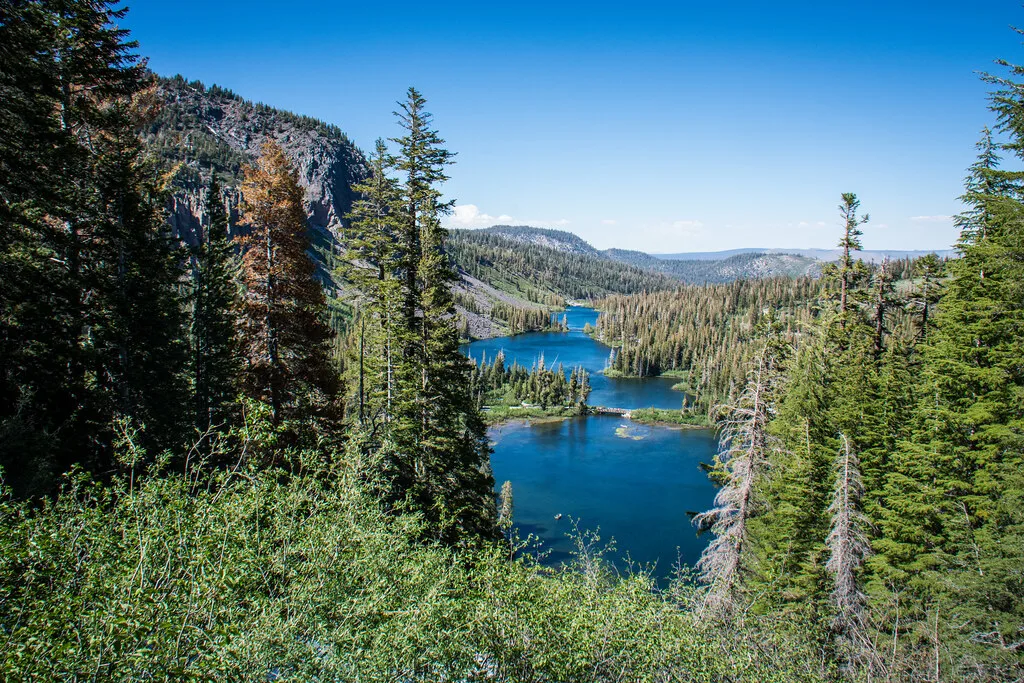
The Mammoth Rock Trail runs about 5 miles round trip beneath the limestone monolith that gives it its name, with views of town and meadows. It is a multi-use route, so mountain bikers come down fast and horseback riders move up, and a dog that lunges at either is a hazard. A short leash and a step off the trail to let bikes pass solves most of it, but a dog with a strong chase drive is better on a quieter route.
This is a good trail for a strong, well-socialized dog on a weekday, when traffic is lighter than on a summer weekend. Keep an ear out for the whir of a freewheel and call your dog close before a bike reaches you. The trade-off for the convenience of a trail in Mammoth's backyard is sharing it.
Inyo Craters: A Short Volcanic Leg-Stretch on Mammoth Scenic Loop
The Inyo Craters trail runs about 2 miles round trip with moderate difficulty, well marked and varied, through forest, open meadow and mountain views. It sits off Mammoth Scenic Loop, which makes it a practical stop on the drive in or out of town rather than a full hiking day. Dogs are allowed on leash, so it works as a leg-stretch for a dog that has been in the car.
The craters formed roughly 600 to 700 years ago, and the short loop gives you a geology lesson without a long climb. Because it is quick, it pairs well with a bakery stop in town, but the bakery itself does not allow pets inside; only service animals go in. Send one person in for pastries while the other waits outside with the dog.
Devils Postpile and Rainbow Falls: Shuttle Rules and the Muzzle Requirement
Devils Postpile National Monument is accessible during peak summer mainly by shuttle from the Mammoth Mountain Adventure Center, since Reds Meadow Road is typically closed to personal vehicles except outside posted early and late windows. The shuttle usually runs from mid-June to mid-September depending on weather and road opening, but the schedule shifts, so check the National Park Service site before you go. Arriving at the edge of the posted window can let you drive in, at the cost of an early start or a late return.
Dogs are allowed on the shuttle buses but must be leashed and muzzled, and muzzles can be bought at local pet stores in Mammoth Lakes or at the Adventure Center near the boarding area. This is the rule most roundups omit, and a dog that has never worn a muzzle should try one at home first. From the ranger station, the trailhead for Devils Postpile and Rainbow Falls is close by, and a mapping app helps on the tangle of trails.
The pay-off is a view of columnar basalt and a waterfall, but the day is dictated by the shuttle rather than by your dog's pace. If your dog will not tolerate a muzzle or crowds, the bus is the wrong setting and the Lakes Basin is the better choice. Otherwise, plan a morning shuttle, carry water and a muzzle that fits comfortably.
Duck Pass and Pika Lake: The Hardest Dog-Friendly Route
Duck Pass and Pika Lake is the most demanding dog-friendly option near Mammoth Lakes, a long high-country route with serious elevation and a rating built on thousands of hiker reviews. AllTrails catalogs dog-friendly trails in the area, and its difficulty ratings and recent reports are the practical way to check snow, water and trail conditions before committing. Only a fit, trail-conditioned dog with a very early start should attempt it.
Think of Duck Pass as a full day rather than an add-on. The altitude, sun exposure and distance stack up, and turning back at the pass is a reasonable outcome. Save it for a trip where the rest of the itinerary is light.
Shady Rest and In-Town Dog Parks for a Low-Effort Day
Not every day needs a summit. Shady Rest is a longtime local favorite for off-leash exercise, and the Mammoth Lakes Dog Park near Cerro Coso College gives you a fenced option in any season, useful when trails are muddy, snowy or closed. Mammoth Mountain also points to Shady Rest, Obsidian Dome and Hot Creek for winter snowshoeing and cross-country skiing with a dog, plus the un-groomed areas around Tamarack Cross-Country Ski Center.
Winter changes the calculus: snow and ice are hard on paws, so booties or paw balm and shorter walks make sense on cold days. A dog park visit before a trail day is a good way to burn energy without committing to mileage. For more fenced options and rules, see Dog Parks in Mammoth Lakes, CA.
Summer and Fall Timing: Altitude, Dry Air and Afternoon Storms
Summer from June to September is the prime hiking window, with trails to Devils Postpile and Rainbow Falls typically accessible, while fall brings fewer crowds and mild weather before some trails begin to close. Winter turns Mammoth into a ski destination, and spring is a mix of lingering snow and newly opened lower trails. Build your plan around the season rather than a fixed itinerary.
Altitude and dry air affect dogs on even short lake walks, so always pack water, and be alert to wildlife in early morning and evening. Afternoon storms are a mountain habit, and exposed lake shorelines and passes are the wrong place to be caught out. A morning hike with a patio lunch after it fits the weather pattern better than a late start.
Post-Hike Patios: Where Dogs Join You After the Trail
Mammoth Mountain publishes a list of pet-friendly patios for the milder months, and it is a solid starting point: Mammoth Brewing Company, Distant Brewing and Shelter Distilling among the breweries and distilleries; The Patty Shack, Yodler Restaurant and Bar, Vulcania, Mountainside Bar and Grill, The Chip Shot Cafe in summer, John's Pizza Works, Roberto's Cafe, The Warming Hut and The Stove in summer among restaurants; plus Stellar Brew and Natural Cafe, Looney Bean and Side Door Wine Bar and Cafe for coffee and wine. Mammoth Brewing's large outdoor patio has mountain views and is a reliable post-hike stop.
Roberto's Cafe on Old Mammoth Road has a large pup-friendly patio and a menu that covers breakfast through dinner, which makes it forgiving when a hike runs long. Vulcania's large patio overlooks the central Village and welcomes dogs, a convenient choice if you are staying near the gondola. Note that the list covers patios in the milder months, so winter dining with a dog is a different problem. For more detail, see Dog-Friendly Restaurants in Mammoth Lakes.
Lodging and Camping Bases for a Hiking Trip
Mammoth Mountain lists three in-town, dog-friendly lodging options: Mammoth Mountain Inn, The Westin Monache Resort and Tamarack Lodge in the cabins only. Pet fees may vary by property, so confirm the current pet policy and fee with the front desk when you book rather than relying on a rate quoted elsewhere. Each base changes your morning: the Inn puts you near the ski area, the Westin sits steps from the Village Gondola, and Tamarack puts forested trails outside the door in the Lakes Basin.
Campers have more options: New Shady Rest and Old Shady Rest campgrounds near town, Convict Lake Campground about 20 minutes away, Twin Lakes Campground, Lake George Campground at 9,000 feet with 16 sites, and the spacious Lake Mary Campground. Dogs are allowed in these campgrounds on leash and under control, and the basin sites put trailheads within walking distance. Compare fees and reservation rules on Dog-Friendly Camping in Mammoth Lakes or browse Dog-Friendly Hotels in Mammoth Lakes for a roofed stay.
Plan Your Dog's Mammoth Hike
Build the trip around one or two hikes with matching trailheads: Horseshoe Lake and McLeod for an easy lake day, Lake Mary or Sherwin Lakes for a moderate half-day, and Duck Pass only if your dog is genuinely trail-fit. Check shuttle and road status for Devils Postpile before you commit to that day, and keep a muzzle handy if you plan to ride.
Pack water beyond what you think you need, a leash that handles cold water, bags, a towel and paw protection for snow or hot pavement. Book lodging with the pet policy confirmed directly, then finish each hike at a patio that publishes dog-friendly seating. For the full town picture, return to the Dog-Friendly Mammoth Lakes guide.
Frequently Asked Questions
What are the best dog-friendly hikes in Mammoth Lakes?
For an easy lake day, the 1.8-mile McLeod Lake trail from the Horseshoe Lake lot pairs a short climb with shoreline swimming. Lake Mary Trail runs about 3.5 miles round trip from the campground trailhead, and Sherwin Lakes climbs over 800 feet across roughly 6 miles for a fitter dog. Duck Pass and Pika Lake is the hardest option and suits only trail-conditioned dogs with early starts.
Are dogs allowed off-leash on Mammoth Lakes trails?
Keep the leash on in town, campgrounds, picnic areas and parking lots. In some undeveloped forest and wilderness areas around Mammoth Lakes, dogs can be under voice command, but neighboring lands such as Yosemite National Park restrict dogs to front-country areas and keep them off trails. Read the trailhead sign and follow the rule for that specific place.
Can dogs ride the Devils Postpile shuttle?
Yes. Dogs are allowed on the shuttle buses but must be leashed and muzzled, and muzzles can be bought at local pet stores in Mammoth Lakes or at the Adventure Center near the boarding area. The shuttle usually runs from mid-June to mid-September depending on weather and road opening, so confirm the current schedule on the National Park Service site.
Is the Mammoth gondola dog-friendly in summer?
Mammoth Mountain says dogs can ride the Panorama Gondola in summer only, and you can hike down one of the on-mountain trails afterward. That is a summer perk, not a year-round service, so check the current operating schedule before planning a day around it.
Which Mammoth Lakes trails are shortest for older dogs?
The McLeod Lake trail from the Horseshoe Lake lot is 1.8 miles round trip, and the Inyo Craters loop is about 2 miles with moderate difficulty. Both are shorter than Sherwin Lakes or Duck Pass. The Horseshoe Lake shoreline itself is flat and sandy, a good option when a dog wants water more than mileage.
Where can you eat with a dog after a hike in Mammoth Lakes?
Mammoth Mountain's list of pet-friendly patios includes Mammoth Brewing Company, Roberto's Cafe, Vulcania, John's Pizza Works and The Warming Hut, plus coffee stops such as Stellar Brew and Looney Bean. The list covers the milder months, so expect fewer patio options in winter. See the Dog-Friendly Restaurants in Mammoth Lakes guide for more detail.
Sources
Notes for your next trip with your dog
Optional updates when we add cities and guides.
You might also like
Continue reading
More guides you'll find useful